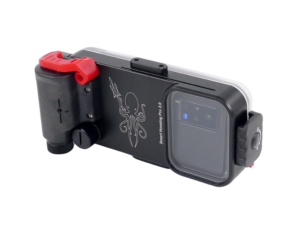
For nearby subjects, a useful GoPro or action-camera light provides a wide white flood, manageable controls and rated runtime that suits your filming. If budget permits, Abyss 6000 is the compact starting recommendation over small strobe-oriented WSR lights. Larger Abyss models add output; larger Hydras remain valid video choices with colour modes, and Spectrum 18000/25000 add three selectable colour temperatures. This guide compares those choices and shows how to build a compatible rig.
Quick Comparison: Kraken Lights for Action Cameras
| Light | Rated lumens / output setting | Modes | Beam | Rated runtime | Best for |
|---|---|---|---|---|---|
| Abyss 6000 | 6,000 continuous / 7,000 burst | White | 120° | 30 min at 100%; 45 min at 80% | Compact white-video starting point |
| Abyss 10000 | 10,000 continuous / 12,000 burst | White | 120° | 35 min at 100%; ~60 min at 80% | Higher-output action-camera video |
| Abyss 20000 | 20,000 continuous / 25,000 burst | White | 120° | 40 min at 100% | Large-light white-video rig |
| Hydra 5000 | 5,000 continuous / 6,000 burst | WRGBU / RGB | 120° | 40 min at 100%; 60 min at 80% (manual) | Compact video plus fluorescence |
| Hydra 10000 | 10,000 continuous / 12,000 burst | WRGBU / RGB | 120° | ~35 min at 100%; ~60 min at ~8,000 lm | White video and colour modes |
| Hydra 12000 | 10,000 standard / 12,000 turbo | WRGBU / RGB | 120° | 60 min standard; 40 min turbo | Longer standard-output runtime |
| Hydra 20000 | 17,000 standard / 20,000 turbo | WRGBU | 120° | 60 min standard; 45 min turbo | New high-output Hydra |
| Spectrum 18000 | Up to 18,000 | 5600K / 8000K / 16,000K | 120° underwater | 35 min full; 50 min at 80% | Less bulk, selectable temperatures; RC02 |
| Spectrum 25000 | 25,000 at 8000K; 15,000 at 5600K / 16,000K | Three selectable temperatures | 120° underwater | 30 min at 25K; 60 min at 15K | Higher maximum output; RC02 |
Burst is shutter-triggered still-photo output, not continuous action-camera video. Turbo is a sustained higher-output setting where listed. Runtime is tied to the output setting; it is not a promise that every dive can be filmed at maximum.
Current pricing: Follow the linked product pages for current prices, configuration choices and availability. Kraken list prices are in USD; Canadian storefront prices convert automatically. No fixed CAD conversion or assembled-rig total is quoted here.
Why Action Cameras Need External Lights Underwater
Your GoPro or DJI looks incredible above the surface. Underwater, the physics work against it.
Water absorbs light wavelengths selectively. Red light disappears by around 5 metres (15 feet). Orange and yellow follow quickly. By 10 metres (33 feet), you’re filming in a blue-green world with almost no warm tones left — no matter how good your camera is. No amount of post-processing fully recovers what was never captured.
Action cameras make this worse than larger camera systems for two reasons. First, their small sensors struggle in low light, which underwater means elevated ISO and noisy footage. Second, their wide-angle lenses — typically 110–170 degrees — capture a huge scene that needs powerful, wide-coverage illumination to look good.
External video lights solve both problems: they restore accurate colour, give your sensor something bright to work with, and allow you to control white balance properly. For action cameras, the priority is simple: as many lumens as possible, as wide a beam as possible, as easy to operate as possible.
Why the Abyss Series Is the Right Choice for Action Cameras
For conventional action-camera footage, white flood output is the main requirement. Small WSR lights offer focus and auto flash-off features aimed at strobe macro photography; those are not the default GoPro selling points. If budget permits, start with Abyss 6000 rather than Hydra 2200 WSR. Larger Hydras remain suitable video lights when you want white output alongside colour modes.
That’s the Abyss series in a nutshell. White flood is the priority, with 100m light depth ratings and brightness control suited to filming. Abyss 6000 and 10000 list button-and-dial controls. Check the exact model’s operation rather than assuming all Abyss lights share an identical interface.
Larger Hydra 5000, Hydra 10000, Hydra 12000 and Hydra 20000 are valid action-camera video options as well as colour/fluorescence lights. Choose Abyss when straightforward white flood is the priority; choose Hydra when you will use those extra modes. Fluorescence capture also depends on the subject, camera and suitable barrier filters—not just turning on UV.
Filters vs. Lights: A Quick Word
Red filters can help with ambient-light colour balance in suitable shallow, bright water, but they remove light rather than adding illumination. The Kraken Smart Housing red filter is for KRH07/KRH08 housings, not a GoPro filter. Choose a filter matched to your action-camera housing; when lighting nearby subjects, check white balance and usually remove the correction filter.
Their limits:
- Below 10 metres: Filters start losing the battle. You’ll still have a blue cast.
- Below 20 metres: Filters are essentially useless. You need light.
- Poor visibility: Filters can make the green/blue cast worse.
- Night diving: Filters do nothing. Artificial light only.
Use a filter for snorkelling and very shallow diving. For actual scuba depths, get a light.
Beam Angle: Why It Matters for Action Cameras
GoPro’s wide mode shoots at roughly 120–155 degrees. DJI Osmo Action 5 is similar. To light that field of view evenly, you need a light with a wide underwater beam — 100 degrees minimum, 110–120 degrees ideal.
A narrow-beam dive torch (for example, 6–15 degrees on current NR models) on a wide-angle action camera creates a hot spot in the centre with dark edges. It looks unnatural. All Kraken Abyss lights are designed with wide underwater beam angles specifically for this kind of coverage.
One Light vs. Two
One light gives you colour restoration. Two independently positioned lights can improve evenness and shadow control. For wide-angle footage — reef walls, fish schools, swim-throughs — two lights on a tray is the right setup. A single light always creates some shadowing on the far side of subjects and uneven falloff across wide scenes.
If budget limits you to one light, position it slightly above and to one side of the camera. Keep it angled in — never pointed straight back toward the lens (backscatter).
The Tray Setup: Don’t Skip This
Even the best lights produce shaky, poorly lit footage if they’re hand-held or clipped awkwardly. A proper tray-and-arm setup stabilises your camera, positions lights at the right angle for even coverage, and keeps your hands comfortable through a full dive.
The TR09 Dual Handle Action Cam Tray is the right starting point. It ships with a GoPro adapter built in and accepts standard 1-inch ball mount accessories. Pair it with one or two KR-FLEX01 Flex Arms to position your lights at the ideal angle.
The TR08 is the adjustable-width alternative for larger housings. Both TR08 and TR09 use pistol-grip handles; the tray does not determine arm strength. Select arms and clamps for the light load, and check camera-mount compatibility.
Abyss Series: Deep Dive by Model
Abyss 6000 — The Entry Point
The Abyss 6000 delivers 6,000 lumens constant and 7,000 in burst mode. For recreational diving in clear water to about 20 metres, this is genuinely capable footage. It uses the same body as the Hydra 5000, meaning it pairs cleanly on a TR09 tray as a dual-light setup.
The Abyss 6000 is rated at 30 minutes at full output or 45 minutes at 80%. Choose power and illuminated shooting time to suit your dive rather than promising a full hour. The compact body works well on an action-camera rig; the KR-FB09 float is listed specifically for Abyss 6000 and Hydra 5000.
- Buy this if: You’re getting into underwater lighting for the first time, diving primarily at recreational depths (10–20m), and want maximum output at this price.
- Skip it if: You run long 60-minute dives at full power — choose a light and output setting with a published runtime that matches your shooting time.
Abyss 10000 — The Sweet Spot
The Abyss 10000 provides 10,000 continuous lumens, a 120° beam and push-button/dial controls. The catalog attributes rate 35 minutes at full power; the description lists approximately 60 minutes at 80%. It is a higher-output step from Abyss 6000, not an hour-at-maximum light.
Choose one or two Abyss 10000 lights according to subject coverage and arm load. Follow the component pages for current prices; no assembled-rig total is quoted because mounts, arms and housing choices differ.
- Buy this if: You want the best balance of output, burn time, and price for serious action camera use. This is the recommendation for most divers.
- Skip it if: You’re on a tight budget — the Abyss 6000 offers a compact lower-output starting point; compare current product-page prices.
Abyss 20000 — Higher White-Light Output
The Abyss 20000 supplies more white-light output for larger close-range compositions, but it cannot illuminate an entire distant reef wall. Water clarity, subject distance, beam positioning and camera exposure still determine the result.
The Abyss 20000 has a 120° underwater flood at 5600K with CRI 90. Rated full-power runtime is 40 minutes at 20,000 lumens. Its catalog weight is 1,400g on land and 565g underwater with battery, so select a suitable arm system and test full-rig buoyancy. Extra output does not remove the need to stay close in water.
- Buy this if: Wide-angle reef, wall, and wreck video is your primary focus and you want the most powerful light in this category.
- Skip it if: You shoot mostly at depths shallower than 10 metres — a large high-output rig may be unnecessary; dim the light and adjust camera exposure rather than assuming shallow water always causes overexposure.
What About the Hydra Series?
Hydra 5000 and Hydra 10000 are capable white-video lights with WRGBU and RGB options for creative or fluorescence work. Hydra 12000 adds a 12,000-lumen turbo setting above 10,000 standard output. Their 120° beams are not unique to the 12K.
The newer Hydra 20000 succeeds the Hydra 18000 at the top of the Hydra range: 17,000 lumens standard for 60 minutes, or 20,000 turbo for 45 minutes. The older Hydra 18000 remains catalog-listed; do not call it the newest flagship.
Spectrum Alternatives
Spectrum 18000 and Spectrum 25000 both offer 5600K, 8000K and 16,000K modes, 120° underwater beams and optional RC02 control. Choose 18K for a smaller, lighter package; choose 25K for higher maximum output, noting that its 25,000-lumen rating applies to 8000K mode, while the other two modes provide 15,000 lumens.
Recommended Tray + Light Packages
Abyss 6000 Action Camera Lighting Kit is the current ready-to-select option: TR09 tray, single or dual Abyss 6000 lights, and either BM3 ball-to-YS arms with one KR-CL clamp per light or FLEX01 arms. Camera and underwater housing are not included. Confirm your housing’s GoPro-style mount and clearance; an adapter may be required.
| Setup | Components / current option | Use case |
|---|---|---|
| Compact single light | Abyss 6000 kit — Single light; TR09 + one Abyss 6000 + one BM3/KR-CL or FLEX01 arm | Nearby subjects; add a second light later |
| Dual-light starting point | Abyss 6000 kit — Dual light; TR09 + two Abyss 6000 lights + two matching arm assemblies | Independent coverage from both sides |
| Higher-output custom rig | TR09 or TR08 + two Abyss 10000 lights; choose compatible arms, mounts and buoyancy | Wide-angle video with brightness headroom |
| Large-light custom rig | TR08 + Abyss 20000 lights with an appropriately supported arm system | Larger close-range reef and wreck compositions |
| Video and fluorescence | Hydra 5000 or Hydra 10000; Hydra 20000 for high-output WRGBU work | White video plus colour / fluorescence modes |
Current pricing: Follow the linked product pages for current prices, configuration choices and availability. Kraken list prices are in USD; Canadian storefront prices convert automatically. No fixed CAD conversion or assembled-rig total is quoted here.
Which Light for Your Situation?
| If you… | Get this |
|---|---|
| Snorkel or dive mostly at 5–20m | Abyss 6000 |
| Want the best all-round action cam light | Abyss 10000 — our top pick |
| Shoot wide-angle reef walls and wrecks | Abyss 20000 |
| Also do UV fluorescence night dives | Hydra 5000 or Hydra 10000 |
| Use both action cam and mirrorless | Hydra 12000 |
Frequently Asked Questions
Do I really need underwater lights for a GoPro?
Below 10 metres (33 feet), yes. Water removes red light almost entirely by that depth, leaving your footage with a flat blue-green cast. No post-processing tool fully recovers colour that was never captured. External lights restore natural colour and give your small sensor the light it needs for clean, low-noise footage. At 5 metres or shallower in bright conditions, a red filter can substitute — but lights are always the better option.
Why Abyss instead of Hydra for a GoPro?
Choose Abyss when your priority is simple white-video output. If budget permits, Abyss 6000 is the more useful action-camera video step than the small Hydra 2200 WSR; its auto flash-off is a strobe-macro feature. Larger Hydras also work well for conventional video and add colour modes when you need them. Spectrum 18000/25000 add selectable colour temperatures and RC02 compatibility.
How many lumens do I need for a GoPro or DJI?
There is no universal lumen minimum. Close subjects need less output than wide compositions competing with bright ambient light. Abyss 6000 is a useful compact starting point; Abyss 10000 adds output, and Abyss 20000 adds substantially more on a larger rig. Positioning two lights can improve evenness, but it does not replace getting close.
Can I mount Kraken lights directly on a GoPro?
The TR09 tray is designed specifically for action cameras and includes a GoPro adapter. Kraken lights mount to the tray via ball mount arms. Direct clip-on mounting isn’t recommended — the light ends up too close to the lens, creating backscatter and hotspots.
Is one Abyss light enough or do I need two?
One light covers close subjects and narrower shots well. For wide-angle footage — reef scenes, fish schools, wrecks — two correctly positioned lights can improve coverage and reduce uneven illumination. Two Abyss 10000 lights on a tray will outperform one Abyss 20000 for evenly-lit wide-angle video.
What’s the difference between Abyss 6000, 10000, and 20000?
The Abyss 6000, 10000 and 20000 are all listed with 120° flood beams, white output and 100m ratings. Sustained output is 6,000, 10,000 and 20,000 lumens respectively; runtime, size and mounting load differ. The 10K is not twice the 6K, and beam width is not the defining distinction.
Do Kraken lights work with Insta360 and DJI cameras?
Lighting is not specific to a camera brand, but mounting still matters. Use the light’s supplied YS or ball mount with a matching arm system. TR09 supplies a GoPro-style camera mount; confirm DJI or Insta360 housing interface and clearance, including any required adapter.