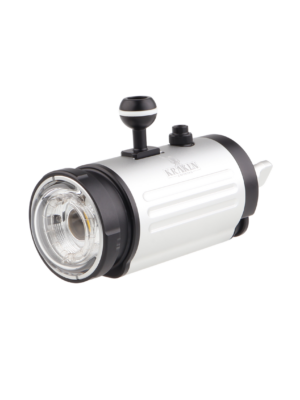
Beam angle determines how your light spreads — and choosing the right one affects your footage, your photos, and how useful the light is as a dive torch. This guide covers what beam angle numbers actually mean underwater, why 120° and 100° are both valid for video, when a narrow beam earns its place on a rig, and when a snoot is the right call.
What Beam Angle Means
Beam angle is measured in degrees and describes the cone of light emitted from the source. It’s typically measured at the point where the light intensity drops to 50% of its peak (the half-power angle). A wider angle means the light spreads over a larger area; a narrower angle means it concentrates the same energy into a tighter cone, producing a brighter centre at the cost of coverage.
What beam angle doesn’t tell you is brightness — that’s lumens. A 120° light and a 15° light at the same lumen rating will look very different in use: the 120° gives broad even coverage, the 15° gives a concentrated beam that punches much further into the water column.
Wide Angle: 120° and 100°
Both 120° and 100° are wide-angle beams designed for underwater video and photography. In practical use the difference between them is subtle — you’re not going to put a 120° and a 100° light side by side and immediately see a meaningful gap in coverage on most subjects.
The difference comes down to optics and housing design. Fitting a wider lens into a compact light body has physical limits — the lens diameter, the reflector geometry, and the housing all constrain how wide you can push the beam. 120° is achievable in a larger head; 100° may be what’s possible in a more compact form factor. The goal in both cases is the same: even, shadow-free coverage across a wide frame with no hotspot in the centre.
Both angles work for:
- Wide-angle video: Full-frame reef coverage, schools of fish, swim-throughs
- Close-focus wide-angle (CFWA) photography: Getting the lens close to a subject while capturing the reef in the background
- Two-light rigs: Overlapping beams to eliminate shadows and create even ambient-style illumination
For reference, the current catalog lists these beams:
| Beam / role | Current models |
|---|---|
| 120° white flood | Hydra 5000, Hydra 10000, Hydra 12000, Hydra 20000, Abyss 6000, Abyss 10000, Abyss 20000 |
| 120° underwater, selectable colour temperatures | Spectrum 18000 and Spectrum 25000 — both 5600K / 8000K / 16,000K and RC02-compatible |
| 120° flood, fixed 16,000K | Spectrum 10000 |
| 110° wide / 15° spot | Hydra 3000 V2 WRGBU |
| 110° wide / 20° spot | Hydra 2200 WSR — compact macro/focus light; catalog currently out of stock |
Hydra 6000 V2 and Hydra 8000 V2 are discontinued 100° examples, not current recommendations. Hydra 18000 remains catalog-listed at 120°, but Hydra 20000 is the newer high-output model. A beam rating is not a guarantee of identical edge brightness; camera field of view, light placement and distance still matter.
Narrow Beams: Dive Torch Design
A narrow beam concentrates light into a tight central hotspot with an outer halo of softer illumination surrounding it. This is the standard design for dive torches, and it’s intentional — it solves problems that wide-angle beams can’t.
A spot torch such as the NR-2500 uses a hot-centre-plus-halo pattern; check the beam design of the exact model. The hotspot serves three distinct purposes:
Current narrow-beam choices include NR-1200 (1,200 lumens, 15°, 75-minute full-power runtime), the new NR-2000 (2,000 lumens, 6°, 70 minutes), and NR-2500 (2,500 lumens, 6°, 85 minutes). The new NR-2000 is not the discontinued original NR-2000; use the canonical current link and do not transfer the old model’s runtime or battery specifications.
Cutting Through Poor Visibility
In low-visibility conditions — silt, plankton bloom, surge-stirred sediment — a wide-angle beam illuminates everything in front of you including the suspended particles, creating backscatter that reduces visible range further. A tight central beam punches through the water column instead of bouncing off it. The concentrated beam reaches further and gives you a usable circle of illumination even when visibility is measured in metres rather than tens of metres.
Peering Into Cracks and Overhangs
Reef diving involves a lot of looking into dark spaces — under ledges, into crevices, behind coral heads. A narrow beam lets you aim precisely into a confined space without flooding the surrounding area with light. You’re directing the photons where you need them, not scattering them across a wide arc. This is where the outer halo earns its role too: it gives you ambient awareness of your surroundings while the hotspot focuses on the point of interest.
Signaling
A tight, bright beam is far more effective for diver-to-diver signaling than a wide flood. In daylight dives, a narrow high-output beam can be seen at significant distance even in bright conditions. The concentrated intensity gets attention in a way that a wide soft light doesn’t.
The Hot Centre and Outer Halo
It’s worth understanding why dive torches produce a halo rather than a perfectly sharp-edged beam. The central hotspot comes from the direct LED output focused by the optic. The halo is produced by light that escapes at the edges of the optic and scatters slightly — it’s dimmer than the hotspot but covers a wider area, giving the diver peripheral awareness without requiring them to sweep the light constantly.
In practice this means Kraken dive torches aren’t pure spotlights — they give you a focused working beam plus enough ambient spillover to navigate comfortably. You get the punch of a narrow beam with the situational awareness of a wider one.
Snooting: Taking Narrow Further
A snoot fits over a compatible strobe or video light and restricts the beam to a tight circle, with spot size determined by optics, aperture and working distance. Where a dive torch’s narrow beam is a practical tool for visibility and navigation, a snoot is a creative tool for underwater photography.
The effect is a precisely controlled spotlight on a single subject — a nudibranch, a blenny poking out of a hole, a shrimp on a coral — with the surrounding reef falling to black. The contrast between the brightly lit subject and the dark background is dramatic and intentional. It’s a technique borrowed from studio portrait photography and adapted for underwater use.
Snooting works best with:
- Macro subjects: Small, stationary animals that you can position the beam on accurately
- Clean backgrounds: The technique is most effective when the background is dark — at depth, or against open water
- Patience: Getting the snoot beam centred on a small subject takes practice. It helps to have a dive buddy hold the snoot light while you operate the camera
The KR-SN10 snoot fits Hydra 3000 V2, current Hydra 5000 and Abyss 6000, but not old Hydra 5000 versions with a round battery. For larger lights, KR-SN09 explicitly lists Hydra 10000/12000/20000, Abyss 10000/20000 and Spectrum 25000; do not infer Spectrum 18000 compatibility. Use white output as the starting point and check working distance and exposure. For strobes, KR-SN07 fits both S80 and S80+ directly; the S80+’s straight tube gives a more directed beam for snoot capture.
For a compact 120° white-video setup, the Abyss 6000 Action Camera Lighting Kit combines the current light with TR09 and a choice of single/dual lighting and BM3/FLEX01 arms. Camera and housing are not included; check the mount and housing depth rating separately. Follow the product page for current USD pricing; Canadian storefront prices convert automatically.
Choosing the Right Beam for Your Diving
- Wide-angle video or CFWA photography: 120° or 100° flood. Both work. Match to your housing and rig setup.
- General recreational diving and poor visibility: Narrow beam dive torch. The hotspot and halo combination handles navigation and signaling better than any flood light.
- Macro photography with creative control: Snoot on a Hydra 5000 or similar. Accept that positioning takes time; the results are worth it.
- Do everything: A wide flood as your primary shooting light plus a narrow dive torch as a backup and signaling device separates imaging from navigation. Overhead diving requires the training, redundancy and equipment specified by your dive plan.
How Beam Angle Fits the Bigger Picture
Beam angle, colour temperature, and CRI are the three specs that together determine whether a dive light is right for your shooting style. Beam angle determines coverage. Colour temperature determines how that light renders on camera. CRI determines how accurately colours reproduce within that light. If you’re still working through the spec sheet, our guides to CRI in underwater video lighting and colour temperature cover the other two pieces.