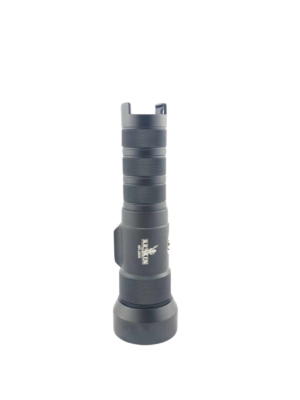
Colour temperature is one of those specs that appears on every dive light listing — 5600K, 5000K, 16,000K — but rarely gets explained in a way that actually helps you make a buying decision. This guide breaks down what the numbers mean, why they matter underwater, and when a non-standard colour temperature like 16,000K is actually the right tool for the job.
What Colour Temperature Actually Measures
Colour temperature is measured in Kelvin (K) and describes the colour of white light on a scale from warm (orange-red) to cool (blue-white). The scale comes from the physics of blackbody radiation — a theoretical object that glows different colours as it’s heated. At lower temperatures, it glows orange-red. At higher temperatures, it glows blue-white.
In practical terms:
- 2700–3000K: Warm white. Incandescent bulbs, candlelight.
- 4000–4500K: Neutral white. Some studio lights, “warm” fluorescents.
- 5000–5600K: Daylight. Midday sun, most underwater video lights.
- 6500K: Overcast daylight. Often used in photography editing monitors.
- 8000–10,000K: Hazy sky or open shade. Getting into blue-white territory.
- 16,000K+: Deep blue. Specialized ambient blue lights for underwater use.
The Kelvin number doesn’t tell you anything about brightness — that’s lumens. It only tells you the colour cast of the light.
Why 5600K Is the Standard for Underwater Video
Most serious underwater video lights — including current Abyss lights and the higher-output Hydra models — run at 5600K. This isn’t arbitrary. There are two reasons it’s become the default:
1. It Matches Daylight White Balance
Daylight white balance around 5500–5600K is a useful starting point for a 5600K video light. Camera presets vary; set or measure white balance for the actual light and scene rather than assuming a preset always removes the colour cast.
This matters most when you’re shooting video. In photography, white balance is easy to correct in RAW. In video, a colour cast baked into the footage requires more work and can degrade quality, especially in compressed codecs.
2. It Restores What Water Takes Away
Water selectively absorbs light by wavelength: reds and oranges generally fade before blue-green light. The amount of colour loss depends on water clarity, lighting and the total light path, not a universal depth cutoff. Keep the light and camera close to the subject to restore useful foreground colour.
A 5600K light is warm enough to restore those lost reds and oranges. When you bring a 5600K source close to your subject at depth, you’re essentially adding back the colour that the water column has removed. The result is footage that looks like the scene actually looks — not the desaturated blue-green you’d get without artificial light.
CRI measures colour rendering relative to a reference at a similar colour temperature. CRI 90 is a useful specification, not a guarantee of perfect footage. Current Abyss lights and Hydra 5000, 10000, 12000 and 20000 list CRI around 90 in white mode; Hydra 3000 V2 lists CRI 82. Spectrum ratings must be read by colour-temperature mode, not applied universally.
When Colour Temperature Varies: The Hydra 3000 V2 and Older Models
Not all lights run at exactly 5600K. The Hydra 3000 V2 WRGBU is a good example of a hybrid design: it runs at 5500K in wide flood mode for video and photography, and switches to a 6500K spot beam that’s intended for use as a dive torch rather than a shooting light. Use wide for shooting and spot for navigation or more concentrated illumination; follow the light’s controls for mode selection. The wide mode is the general-video starting point; a spot can serve targeted work. Test white balance for the actual mode rather than assuming 5500K and 5600K sources always render identically.
The discontinued Hydra 3000 runs at 6500K, which is slightly cooler (bluer) than the current lineup. The difference between 5600K and 6500K is subtle but present: a 6500K source will render slightly cool, and if you’re mixing it with a 5600K light in a two-light rig, you’ll see a mild colour cast between the two beams. For single-light setups, the difference is trivial and easy to correct in post.
Understanding 16,000K: A Different Tool for a Different Job
The Spectrum 18000 and Spectrum 25,000 both offer three selectable colour temperatures: 5600K, 8000K, and 16,000K. The Spectrum 10,000 runs specifically at 16,000K. Understanding why requires a different way of thinking about colour temperature.
At 16,000K, the output is strongly blue-shifted relative to a daylight-balanced video light. It is an ambient-blending option for suitable conditions, rather than the default foreground-colour setting. Its practical uses and limits include:
Ambient Fill That Matches the Water Column
When you’re shooting wide-angle footage at depth, there’s often a conflict between your foreground (lit by your primary white light) and your background (lit by ambient blue-green water light). The foreground renders warm and correctly coloured; the background is a blue void. The tonal separation can look artificial, especially if you’re after a natural, immersive look.
A 16,000K source can help blend added light on nearby subjects with blue-water surroundings. It cannot illuminate distant open water or an entire background; working distance, water colour and camera white balance determine the result. The Spectrum 18000 and 25000 also offer 5600K and 8000K, so they are not blue-only lights.
Blue-Channel Depth in Video
Exposure and camera processing determine colour-grading latitude. Ambient-blue lighting can change the balance on subjects within its reach, but it does not guarantee more usable blue-channel data or prevent banding. Avoid clipping channels and choose white balance deliberately.
Creative and Fluorescence Work
Colour temperature alone does not establish fluorescence-excitation performance. For dedicated fluorescence work, choose a verified blue/UV mode such as those on Hydra 5000 or Hydra 20000 WRGBU, with suitable camera and viewing barrier filters. Follow safe-use instructions and avoid shining intense light into eyes; do not infer UV capability from a 16,000K white-light specification.
Colour Temperature Across the Kraken Line
Current choices and selected legacy references:
| Model | Colour temperature | How to read the specification |
|---|---|---|
| Hydra 2200 WSR | 5000K flood / 6500K spot | Current WSR; macro focus and diving |
| Hydra 3000 V2 WRGBU | 5500K wide / 6500K spot | Current WRGBU; CRI 82 |
| Hydra 5000 | 5600K | Current white-mode CRI 90 |
| Hydra 10000 WRGBU | Approx. 5600K | Current white-mode CRI ~90 |
| Hydra 12,000 | 5600K | 10,000 constant / 12,000 turbo |
| Hydra 20000 WRGBU | 5600K | Current Hydra flagship; CRI 90 white |
| Abyss 6000 | 5600K | 6,000 white flood; action-camera recommendation |
| Abyss 10000 | 5600K | 10,000 white flood |
| Abyss 20,000 | 5600K | 20,000 white flood |
| Spectrum 18000 Underwater Video Light | 5600K / 8000K / 16,000K selectable | RC02; 97.92 Wh; Check current CRI specification |
| Spectrum 25,000 | 5600K / 8000K / 16,000K selectable | RC02; CRI 90 listed for 5600K and 16,000K, not universally |
| Spectrum 10,000 | 16,000K fixed | Ambient-blue specialist; RC02 |
| Hydra 3000 | 6500K | Discontinued; existing-owner reference |
| Hydra 6000 V2 | 5000K | Discontinued; existing-owner reference |
| Hydra 8000 V2 | 5000K | Discontinued; existing-owner reference |
For ordinary action-camera video, choose Abyss 6000 when budget permits: 5600K, CRI 90 and a 120° white flood. Higher Hydras remain useful video and fluorescence options when you want WRGBU channels. Match the actual operating mode of paired lights and test white balance before the dive; equal Kelvin numbers alone do not guarantee identical spectra.
Practical White Balance Settings
If you’re shooting with a 5600K Kraken light as your primary source:
- Video: Set camera white balance to Daylight (5500–5600K). This is the cleanest starting point. Avoid Auto WB in video — it will shift as you move the camera.
- Photo (RAW): Shoot Auto WB or Daylight and correct in post. RAW usually gives more adjustment latitude, but missing wavelengths, clipped channels and underexposure cannot be recovered without limit.
- Photo (JPEG): Set to Daylight or use a custom white balance set by pointing the light at a white card close to your subject. This is the most accurate method for JPEG shooters.
- Mixed ambient + artificial: If you’re using a 5600K light close to the subject but relying on ambient light in the background, expect a blue-to-warm gradient. This is physically accurate — it’s what the scene actually looks like. Adjust exposure and white balance deliberately; a blue-shifted source can help blend nearby lit subjects but cannot fill the distant background.
The Bottom Line
Around 5600K is a practical white-light starting point for underwater video and photography. For ambient blending, compare fixed-blue Spectrum 10,000 with selectable Spectrum 18000 Underwater Video Light and Spectrum 25,000. Both selectable models support RC02 remote control. The 25K reaches 25,000 lumens in 8000K mode, while its 5600K and 16,000K settings deliver 15,000 lumens; do not equate a model name with output in every mode.
Colour temperature is one spec — CRI tells you the other half of the story. If you haven’t read our guide to CRI in underwater video lighting, that’s the logical next step.
Frequently Asked Questions
Does 16,000K mean UV?
No. Kelvin describes the colour of white light, not a UV wavelength or fluorescence mode.
Which Spectrum is easier to pack?
Spectrum 18000 Underwater Video Light is 990g with a 97.92 Wh battery; Spectrum 25,000 is 1,410g with a 144 Wh pack. Verify every operating airline’s policy; the larger pack is in the category normally requiring airline approval, not universally travel-safe.