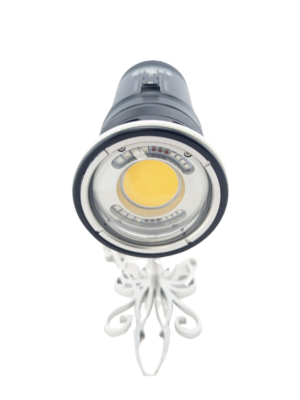
Best Underwater Video Lights 2026: Kraken Hydra, Abyss & LTD Series Compared
Choosing an underwater video light comes down to three things: how much light you actually need at depth, whether you want colour modes beyond white, and how you want to carry it. This guide covers the full Kraken video light lineup — from compact travel-friendly options to high-output rigs for serious video work — with honest notes on what each one does well and where it falls short.
If you’re in a hurry, jump to the Quick Answer below. If you want to understand why lumens matter differently at 5m vs 20m, what WRGBU actually does for your footage, and which light fits your style of diving, read on.
⚡ Quick Answer
- ✅ Budget/travel: LTD 3000 ($249) or Abyss 6000 ($399)
- ✅ GoPro / action cam: Abyss 10000 ($499) — serious output in a compact body
- ✅ First WRGBU light: Hydra 3000 V2 WRGBU ($325)
- ✅ Best all-around: Hydra 8000 WRGBU ($799) — power, colour modes, CRI 90
- ✅ Serious video production: Hydra 12,000 ($799)
- ✅ Maximum output: Hydra 18000 ($1,150) — 18,000 lumens constant
Why Lumens Matter Differently at Depth
Water absorbs light aggressively — and it gets worse as you go deeper. A 3,000-lumen light at 3 metres on a reef gives you usable illumination across a wide scene. That same 3,000 lumens at 20 metres in open blue water barely reaches your subject. The physics are unforgiving: light scatters off suspended particles, loses intensity with distance, and gets colour-shifted by the water column.
This is why lumen count that looks generous in spec sheets sometimes disappoints in real use. If you’re diving shallow reefs in clear tropical water, a 3,000-6,000 lumen light is genuinely capable. If you’re pushing 25m on wrecks or working in temperate water with any visibility reduction, you want 10,000+ lumens as your baseline. More output also gives you more working distance — you can light a subject from further away, which reduces backscatter and gives you more creative options.
Why WRGBU Matters for Underwater Video
Most video lights produce white light only. The Hydra series adds Red, Green, Blue, and UV LEDs alongside white — and each mode has a genuine use case, not just a spec sheet checkbox.
- White (W): Your primary working mode for filming and photography. This is what you use 90% of the time.
- Red (R): Red light is invisible to most marine life — fish and crustaceans don’t react to it the way they do to white light. Critical for night dives where you want to observe natural behaviour without disturbing it. Also produces minimal backscatter in low-vis conditions.
- Green (G): Cuts through certain water conditions differently than white. Some photographers find it useful for attracting bioluminescent plankton or specific critters.
- Blue (B): Triggers fluorescence in corals, anemones, and some fish species. Pair it with a yellow barrier filter on your lens for fluorescence photography — it’s a completely different visual world.
- UV (U): Stronger fluorescence trigger than blue, useful for specific fluorescence photography setups.
If you only ever shoot travel video on reef dives in the daytime, you may never use red or blue. But if you do any night diving, behaviour work, or creative fluorescence photography, WRGBU is a genuinely useful tool — not a gimmick.
CRI 90 — Why Colour Accuracy Matters for Video
CRI stands for Color Rendering Index. A CRI of 90 means the light renders colours at 90% accuracy compared to natural sunlight. Lower CRI lights — common in cheaper video lights — make greens look wrong, crush reds, and produce footage that needs heavy correction in post that you often can’t fully fix.
For photography, you have more latitude because you’re correcting a single frame. For video, you’re colour grading thousands of frames — and poor CRI makes that work much harder. The Hydra series is rated CRI ~90, which is a meaningful spec for anyone serious about video quality.
Full Comparison Table
| Model | Lumens | WRGBU | CRI | Price (USD) | Best For |
|---|---|---|---|---|---|
| LTD 3000 | 3,000 | — | — | $249 | Budget travel, flood/spot modes |
| Hydra 3000 V2 WRGBU | 3,000 | ✅ | 82 | $325 | WRGBU entry, night diving |
| Abyss 6000 | 6,000 | — | — | $399 | Compact camera, travel |
| Hydra 5000 WRGBU | 5,000 | ✅ | ~90 | $399 | WRGBU mid-range |
| Abyss 10000 | 10,000 | — | — | $499 | GoPro/action cam, compact rigs |
| Hydra 8000 WRGBU | 8,000 | ✅ | ~90 | $799 | All-around serious video |
| Hydra 12,000 | 12,000 | ✅ | 90 | $799 | Video production, wide angle |
| Hydra 15000 WRGBU | 15,000 | ✅ | 90 | $1,150 | High output WRGBU |
| Hydra 18000 | 18,000 | ✅ | 90 | $1,150 | Maximum constant output |
Entry Tier: $249–$399
LTD 3000 — $249 USD
3,000 lumens | Flood + Spot | Compact | White only
The entry point into Kraken video lighting. Compact, light, and affordable — it fits on a GoPro tray without dominating the rig. What sets it apart from a basic single-mode light: switchable flood and spot beams. Flood gives you wide coverage for general filming; spot concentrates the beam for reaching a subject at distance or highlighting specific detail. White light only, no colour modes, but for travel diving and shallow reef work, it does the job well.
Honest limitation: White only, no WRGBU. At significant depth or in real low-viz, 3,000 lumens runs out of reach. If you want red mode for night diving or blue for fluorescence, you’ll need to step up to a Hydra.
Hydra 3000 V2 WRGBU — $325 USD
3,000 lumens | WRGBU | CRI 82
This is where the Hydra series starts. Same lumen output as the LTD 3000 but with the full WRGBU colour array — White, Red, Green, Blue, UV. The Hydra form factor is larger than the LTD, but you’re getting significantly more capability. The red mode alone makes this worth the step up if you do any night diving; marine life that would flee from white light often ignores red completely.
Note: CRI is 82 on this model — a step down from the CRI 90 on the Hydra 5000 and up. If colour accuracy for video is critical, the Hydra 5000 is worth the extra spend. But for general diving with colour mode capability, the 3000 V2 is solid.
Honest limitation: 3,000 lumens is modest at depth. CRI 82 vs 90 on the higher models. No fiber optic port — not RC02 compatible.
Abyss 6000 — $399 USD
6,000 lumens | Compact | White | USB-C | 100m rated
Double the output of the LTDs in a compact body that’s still travel-friendly. USB-C rechargeable, depth rated to 100m. This is the light we’d recommend to most recreational divers shooting compact cameras — it’s capable enough for a real range of conditions, doesn’t require a dedicated tray, and the price is genuinely accessible. On a reef at 15m with decent visibility, 6,000 lumens feels like plenty of light.
Honest limitation: White only. Compact body means the battery isn’t massive — check burn time for your dive profile.
Mid-Range: $399–$799
Hydra 5000 WRGBU — $399 USD
5,000 lumens | WRGBU | CRI ~90
The sweet spot for divers who want WRGBU capability with meaningful lumen output. 5,000 lumens handles most recreational diving scenarios with room to spare, and the CRI 90 rating means your footage actually looks good without heavy colour correction. All the colour modes from the Hydra 3000 V2, but with notably more output for deeper water or wider coverage.
If the Hydra 3000 V2 is the right idea but you want more headroom, this is the step up.
Abyss 10000 — $499 USD
10,000 lumens | Compact | White | USB-C | 100m rated
This is the one to get if you’re running a GoPro, action camera, or compact system and want real, professional-grade output. 10,000 lumens in the compact Abyss body is a serious amount of light — it reaches further, handles worse visibility, and gives you the kind of subject separation that makes footage look cinematic rather than tourist-snapshot. At $499 USD, it punches well above its weight.
The tradeoff versus the Hydra series: white only, no colour modes. If you’re purely shooting video and not doing night observation work, that’s often fine.
Honest limitation: No WRGBU. If you want red for night diving or blue for fluorescence, this isn’t the one.
Hydra 8000 WRGBU — $799 USD
8,000 lumens constant | WRGBU | CRI 90 | 120° beam | 100m rated
This is the best all-around underwater video light in the Kraken lineup for most serious divers. 8,000 lumens is enough output for meaningful work at depth — wrecks, walls, wider scenes. The WRGBU array gives you every colour mode you’d practically need. CRI 90 means your footage renders accurately without wrestling with white balance in post. And the 120° beam angle is wide enough for wide-angle setups without hotspots.
Compatible with the RC02 Remote (Hydra 5000 V2 and up, Abyss series, LTD 5000 and up) — adjust power from your tray via fiber optic cable without reaching out on the arms. If you’re running two of these in a paired rig, that’s a genuinely useful feature mid-dive.
If you’re buying one light for a serious rig and want to cover most situations, the Hydra 8000 is the answer.
High Output: $799–$1,150
Hydra 12,000 — $799 USD
12,000 lumens constant | WRGBU | CRI 90 | 120° beam | 4×21700 battery | ~60 min @ 100% | RC02 compatible
At $799 USD, the Hydra 12,000 shares a price point with the 8000 but delivers 50% more output. For divers shooting wide-angle video at depth — wrecks, reef walls, big animal photography — the extra lumens make a real difference in how far your light reaches before it falls off. Full WRGBU, CRI 90, 120° beam. Powered by a 4×21700 battery pack for ~60 minutes at full output.
RC02 compatible — if you’re running a paired rig with two of these, you can control both from the tray simultaneously or independently without touching the lights.
This is the step up from the 8000 if you consistently find yourself wanting more reach or shooting wider scenes.
Hydra 15000 WRGBU — $1,150 USD
15,000 lumens | WRGBU | CRI 90 | 100m rated
For divers who need serious sustained output with the full WRGBU colour array. 15,000 lumens covers large scenes at depth, handles challenging visibility, and gives paired-rig setups enough power to properly expose wide-angle footage in conditions where lesser lights fall flat.
Hydra 18000 — $1,150 USD
18,000 lumens CONSTANT | WRGBU | CRI 90 | 5600K | 120° beam | RC02 compatible
The top of the Kraken lineup. 18,000 lumens is the constant working output — this isn’t a burst spec or a peak claim. Burst mode takes it beyond that for short sequences when you need to overpower ambient light or fill a large subject at distance. The 120° beam at 5600K with CRI 90 means you’re getting accurate, wide, cinema-quality light.
RC02 compatible. Triple-button control with battery indicator. For documentary work, professional video production, or any diver who’s used a smaller Hydra and found themselves consistently wanting more output, this is where you end up.
The jump from 12,000 to 18,000 lumens is meaningful in practice — you’ll see it most in how your footage handles ambient light in the 15-25m range where most serious diving happens.
Complete Your Rig
Most lights in the Hydra series are designed to be mounted on arms, not hand-held. A proper tray-and-arm setup makes a significant difference to shot stability, positioning, and buoyancy control.
- TR08 Dual Handle Pistol Grip Tray — our most popular tray for video rigs. Two-handed control, ball mount arms, stable platform.
- Full tray and arm selection — ball arms, float arms, single-handle trays.
- RC02 Remote Control — connects via fiber optic cable, lets you adjust power on multiple lights from the tray without reaching out on the arms. Compatible with Hydra 5000 V2 and up, Abyss series, and LTD 5000 and up. Note: Hydra 3000 V2 and LTD 3000 do not have a fiber optic port and are not RC02 compatible.
Not sure what goes together? Contact us — we spec rigs for customers regularly and can tell you exactly what fits your camera system and how you dive.