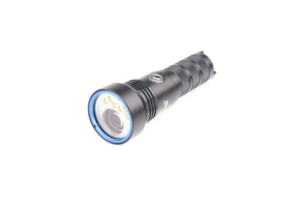
Most dive lights work the same way: a cluster of LEDs, a reflector, and a beam that fans out more or less depending on the optics. The NR-LEP01 does something fundamentally different. It uses a single LEP module — Laser Excited Phosphor — to produce a spot beam that behaves unlike anything in conventional dive lighting. If you’ve never heard of LEP, that’s fine. Most divers haven’t. This guide explains what it actually is, what it does underwater that LED can’t, and whether it makes sense for how you dive.
What Is LEP? (The Short Version)
LEP stands for Laser Excited Phosphor. Instead of an LED chip producing light directly, a blue laser is focused onto a tiny piece of phosphor material. The laser excites the phosphor, which converts that energy into bright, broad-spectrum white light. The result is a beam with unusually high intensity concentrated into an extremely tight angle — the NR-LEP01’s spot beam is 3 degrees.
For comparison, NR-1800 and the new NR-2000 list 6° LED spots, while NR-1200 lists a 15° spot. The NR-LEP01 lists a 3° LEP spot and a 100° LED flood. Beam angle describes coverage, not a guaranteed underwater range.
LEP converts laser excitation into white light through phosphor. That does not make an intense beam safe to shine into eyes: avoid looking into it or aiming at divers’ or animals’ eyes, and follow the operating instructions. Do not open or modify the optical assembly.
Why LEP Works Differently Underwater
Water is full of particles — suspended sediment, plankton, microscopic life. When a wide-angle light hits those particles, it scatters back toward the camera or your eyes as backscatter. A tighter beam illuminates a smaller cone, but range still depends on intensity, water attenuation and viewing geometry.
A narrow beam lights a smaller cone of water and can help with targeted signalling and inspection. It does not thread between particles or bypass scattering; useful reach depends on water clarity, beam intensity and positioning. No fixed multiplier over LED torches is established here.
The tradeoff is obvious: a 3° beam can’t illuminate a scene. You’re not going to light a reef with a LEP spot. It’s a precision tool, not a floodlight — which is exactly why the NR-LEP01 pairs it with a 2,500-lumen LED flood at 100°.
The NR-LEP01: Dual Light System
The NR-LEP01 combines both lighting modes in one body:
- LEP Spot: 8W single LEP module, 3° beam angle, 5000K colour temperature. 120 minutes at 100% power.
- LED Flood: 2,500 lumens, 100° wide beam, 6500K. 60 minutes at 100% power. Push-button with battery-level indicator.
You switch between modes on the same body. On a single dive you might use the LED flood to navigate and illuminate your general surroundings, then switch to LEP when you’re critter hunting, signalling your buddy, or pushing into a long wreck corridor. They serve different functions and you choose the right tool for the moment.
The LED flood is 6500K and the LEP spot is 5000K. Either may be useful for targeted illumination, but the narrow spot is not a substitute for an even video flood or a dedicated macro snoot. Guide numbers should not be compared without a common measurement method; the current NR-LEP01 catalog does not establish the old GN32 claim.
Who Actually Uses LEP?
LEP isn’t for every diver. Here’s where it earns its place:
Dive Guides and Instructors
A concentrated spot can help guides direct attention to a location. Actual visibility varies with distance and water clarity. Point beside a subject rather than into its eyes, avoid disturbing animals, and agree on communication signals with the group.
Blackwater and Open Ocean Diving
Blackwater diving — hanging a light below the boat at depth and waiting for planktonic creatures to migrate up through the water column — produces encounters with juvenile fish, larvaceans, and creatures most divers never see. LEP’s intense spot beam is ideal for illuminating individual subjects against the black background, and for signalling your boat or buddy across open water where a flood would scatter and diffuse.
Wreck Diving
A narrow spot can be useful for inspecting a wreck corridor, but suspended sediment still scatters light. Keep the beam out of the direct viewing path where practical. Wreck penetration requires appropriate training, redundant lighting and a dive plan; a dual-mode torch is not two independent backup lights.
Search and Signal
For search and signalling, concentrated light can be useful, but above-water beam-distance ratings do not establish underwater range. Test visibility in the actual conditions and carry the signalling equipment required for the dive; no universal LEP-versus-LED range advantage at equal electrical power is claimed here.
LEP-Only vs Dual-Mode: What to Consider
Some LEP dive lights on the market are purely spot tools — LEP only, no flood. They’re compact and excellent for signalling or pointing, but they can’t illuminate a scene. You’d need a separate primary light alongside them.
The NR-LEP01 takes a different approach: integrate LEP with a real 2,500-lumen LED flood in one body, so the light covers both functions. On a single dive you have ambient illumination for navigation and general diving, and a precision LEP spot when you need it. It’s the difference between a specialist tool and a complete system.
The practical design rationale is to combine a precision spot and a general-illumination flood in one body. That is convenient, but one battery or light failure affects both modes; retain independent backup lighting whenever your dive plan requires it.
Technical Specs
- LEP Module: 8W single module, 3° beam angle, 5000K, 120 min @ 100%
- LED Flood: 2,500 lumens, 100° beam, 6500K, 60 min @ 100%
- Battery: 26650 cell, USB-C rechargeable
- Depth Rating: 100m / 330ft
- Switch: Push-button with battery level indicator
- Dimensions: 54.5mm diameter × 162mm length
- Weight: 388g on land / 211g underwater
- Modes: LED flood / LEP spot; current description also lists Red and safety modes—confirm controls in the supplied instructions.
- Price: $465 USD
Ready to add LEP to your rig?
Questions about whether LEP suits your dive style? Ask our team — we’ve been diving with this light since it launched.
Price and currency: Prices quoted here are USD base prices from the current catalog. Canadian shoppers see CAD using the store’s current conversion. Check the linked product page, selected configuration and checkout for current price, currency, availability and shipping; no fixed Canadian conversion is assumed.
Frequently Asked Questions
Is NR-LEP01 the same as NR-2500?
No. NR-LEP01 combines an 8W LEP spot and 2,500-lumen LED flood. NR-2500 is a 2,500-lumen LED spot torch, not an “NR-2500 LEP”.
Should I buy LEP for normal action-camera video?
For normal video, choose a broad white flood such as Abyss 6000 when budget permits. LEP is a targeted signalling/inspection tool rather than the default wide-angle filming recommendation.
Does its USB-C connection mean any charger works?
No. Use the supplied or confirmed compatible charging equipment. The catalog establishes USB-C charging but does not specify an arbitrary replacement charger’s required profiles.